
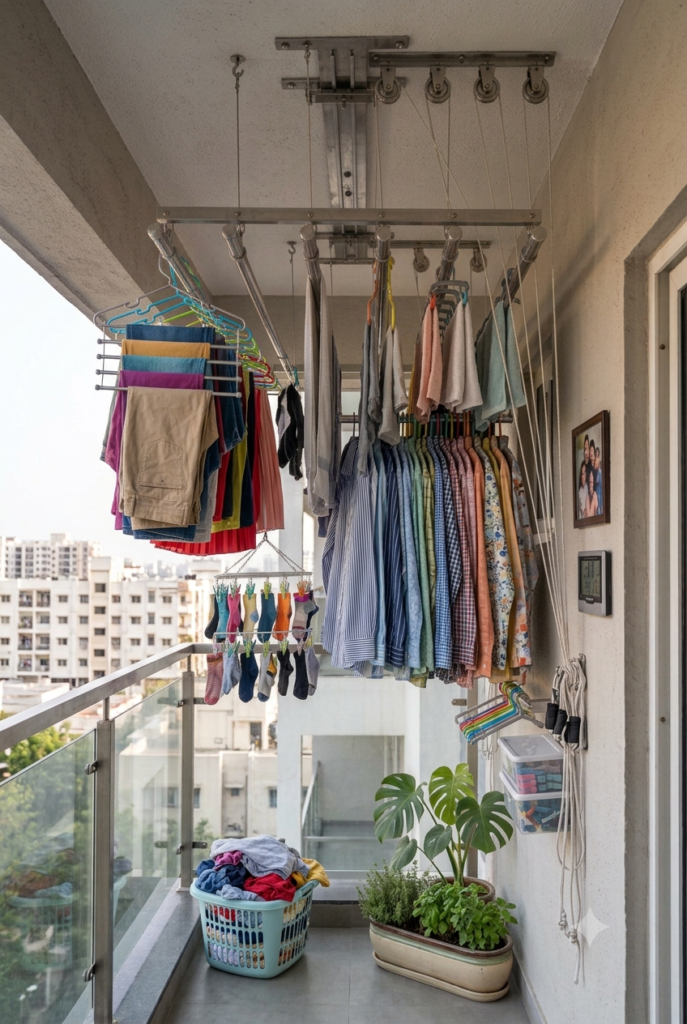
If you’ve ever stubbed your toe on a drying rack on your way out to water the plants, or given up the one decent corner of your balcony to a row of wet shirts, you know the problem already. Balconies in most apartments today just aren’t big and a drying rack eats up whatever little space you have.
The good news is you don’t need a bigger balcony to fix this. You just need a smarter way to dry your clothes. That’s really what a ceiling cloth hanger is for.
Here’s how it works, why it tends to suit apartment balconies so much better than a floor rack, and a few things worth thinking about before you get one installed, whether you’re in Hyderabad or Kurnool.
The trouble with regular drying racks
Floor-standing racks were made for a different kind of home – one with a bit more room to spare. In a typical apartment, they end up causing the same few headaches:
- They sit right in the middle of your balcony, so there’s nowhere left to walk, sit, or keep anything else.
- They wobble in strong wind, and a rack full of wet, heavy clothes can genuinely tip over.
- They just don’t hold that much compared to a proper ceiling setup.
- You end up shifting them around every time you want to actually use the balcony for something else.
If your balcony has quietly turned into a permanent laundry corner, this is usually why.
So what exactly is a ceiling cloth hanger?
It’s a pulley-based drying system fixed to the ceiling of your balcony or utility area. Most have four to six individual rods, and each one can be lowered on its own to load clothes, then pulled back up once it’s loaded so your floor stays completely clear.
You’ll generally come across three types:
- Pulley (rope-operated) hangers — the classic, budget-friendly option. A simple pull raises or lowers each rod.
- Wall-mounted hangers — useful if you have a false ceiling or POP work where drilling into the ceiling isn’t really an option.
- Foldable ceiling racks — fold flat when not in use, which works well if your balcony is on the smaller side.
How much space do you actually get back?
This is really the whole point. A regular three-tier drying rack takes up a good few square feet of floor space and you can’t really use that space for anything while clothes are drying on it. In a small balcony, that’s often most of what you have.
With a ceiling hanger, once the rods are up, you get the floor back entirely. No walking around wet towels, no rearranging furniture around a rack just an empty balcony again, ready for a chair, a plant, or nothing at all.
Why is this more relevant now
Newer apartments and gated communities in Hyderabad and Kurnool tend to come with smaller, more compact balconies than the independent houses many of us grew up in, where there was often a whole terrace or open yard for drying clothes. That space just isn’t a given anymore, which is really what makes a vertical drying setup worth considering rather than a nice-to-have.
A few situations where it tends to make a real difference:
- A narrow or L-shaped balcony where a rack simply won’t fit alongside anything else
- Higher floors, where wind makes a floor rack genuinely risky
- A utility area already shared with the washing machine, where floor space is tight to begin with
- Rented homes, where wall-mounted clamps avoid the need for permanent ceiling drilling
Other things you’ll notice once you switch
- Clothes tend to dry a bit faster, simply because they’re catching more airflow up near the ceiling than tucked in a corner
- You can lower just the rod you need instead of dealing with the whole rack
- It holds heavier things like bedsheets and blankets far better than a lightweight rack would
- The balcony looks a lot tidier when you have guests over and there’s nothing hanging out to dry
- It’s easy enough for anyone in the house to use, including elders or kids, since it’s just a smooth pull up or down
A few things worth checking before you install one
- Your ceiling type matters. A solid RCC concrete ceiling holds brackets securely. If you have a false ceiling or POP work, a wall-mounted version is usually the safer bet.
- Think about how heavy your laundry usually gets. If you regularly dry blankets or bedsheets, go for a hanger rated for that weight rather than the cheapest option available.
- Get the size right for your balcony, both in terms of rod length and how many rods you actually need; this depends more on your household’s laundry load than on price.
- Have it installed properly. Loose brackets or a shallow drill hole are the most common reason hangers come loose after a few months. It’s not really a job worth doing yourself unless you’re confident with masonry drilling and know how to judge load-bearing points.
Worth doing sooner rather than later
A ceiling cloth hanger isn’t just another drying gadget; it’s one of the easiest ways to get a chunk of your balcony back, permanently. If your balcony has become a full-time laundry spot, this is the single change that would make the biggest difference for the least effort.
If you’re in Hyderabad or Kurnool and need help determining the right size and setup for your balcony, contact us. We’re happy to take a look and provide a straightforward quote.
